Anthropic’s Claude Now Leads 26% of AI R&D as Company Expands Into Biology
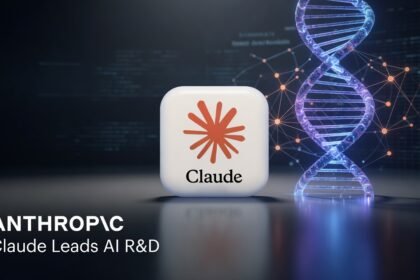
AI startup Anthropic has reported a sharp increase in the role of its Claude model in developing the company’s own artificial intelligence systems. As of August 2026, Claude was able to lead 26% of Anthropic’s AI research and development work, compared with less than 1% in February, according to metrics released by the company.
The development highlights how AI models are increasingly being used not only as software tools but also as participants in the research process used to build future AI systems.
At the same time, Anthropic has expanded its work in life sciences, including the establishment of a wet biology laboratory in the San Francisco Bay Area where researchers can conduct physical biological experiments alongside computational research.
Claude’s Role in Anthropic’s AI R&D
Anthropic’s latest figures show that Claude’s role in internal AI development has grown considerably in a matter of months.
The company said Claude now leads 26% of its AI R&D work, meaning it can handle most of the work involved in a task from a high-level prompt through completion while a human remains responsible for supervision. In February, the comparable share was below 1%.
Anthropic also said more than 90% of its AI R&D work is now performed at a level where AI either collaborates with humans or leads the work.
However, the company stressed that Claude is not fully autonomous in any measured area of its R&D operations. Human oversight remains part of the process.
Anthropic Tracks the Pace of AI-Assisted Development
To measure the changing role of AI inside its research organisation, Anthropic created an R&D Automation Index. The company catalogued thousands of individual research and engineering tasks and assessed how much AI could contribute to each one.
The measurement distinguishes between AI collaborating on a task and AI leading it. Anthropic uses an automation scale developed with reference to work by Epoch AI, with the highest relevant level describing situations where an AI system completes most of a task after receiving high-level direction while a human supervises.
Anthropic has said it plans to publish such measurements regularly to provide greater visibility into the pace at which AI systems are becoming capable of contributing to AI development.
What the Shift Means for AI Development
The increasing use of Claude in Anthropic’s own R&D could potentially shorten some parts of the AI development cycle.
AI systems can already assist researchers with activities such as coding, debugging, data analysis, evaluation and scientific research. When models begin handling larger portions of these workflows, researchers can devote more time to setting objectives, reviewing results and addressing problems that require human judgment.
Anthropic has described this development in the context of recursive self-improvement, a scenario in which AI systems could increasingly contribute to the development of more capable successors.
The company has not said that Claude is currently capable of independently improving itself. Instead, its latest measurements show that AI is taking on a growing share of the work involved in developing future models while humans remain involved.
Anthropic Quietly Establishes Biology Lab
Alongside its AI development work, Anthropic is expanding into physical biological research.
The company has established a wet biology lab in the San Francisco Bay Area, according to Reuters. The facility allows Anthropic to conduct physical experiments that complement its computational research. Anthropic’s head of life sciences, Eric Kauderer-Abrams, confirmed that the company is conducting some research internally while also working with outside partners.
The move is significant because biological research ultimately requires experiments in the physical world. AI can help analyse data, generate hypotheses and design potential molecules or proteins, but laboratory testing is necessary to determine whether computational predictions work in practice.
AI-Driven Drug Discovery Becomes a Major Focus
Anthropic has been building its life-sciences capabilities for some time. The company launched Claude for Life Sciences in 2025 and has since expanded partnerships and research programmes designed to apply Claude to scientific discovery.
In February 2026, Anthropic announced partnerships with the Allen Institute and Howard Hughes Medical Institute to apply Claude to biological research and scientific discovery.
More recently, Anthropic has demonstrated Claude’s ability to assist with protein design and other biological modelling tasks. In September, the company said Claude had optimized more than 30 open-source biological models, making them roughly four times faster on average while maintaining limited losses in precision.
The company has also reported experiments involving the design of protein binders, a process relevant to early-stage drug development.
From Computer-Based Research to Wet-Lab Experiments
Anthropic’s biology strategy now spans both in-silico research and physical laboratory work.
Computational systems can help researchers search biological databases, analyse molecular structures, design proteins and identify potential drug candidates. A wet lab adds the experimental stage, allowing researchers to test whether those computational predictions translate into real biological results.
Reuters reported that Anthropic is particularly interested in applying its technology to under-researched rare diseases and conditions that have historically received limited attention from drug developers. The company is not currently conducting clinical trials itself.
Claude’s Growing Scientific Capabilities
Anthropic’s recent research suggests that the company sees Claude as more than a general-purpose chatbot.
The company has been developing specialised capabilities for scientific workflows, including biological modelling, protein design, chemical analysis and research automation. Its AI for Science programme has also supported researchers working on areas such as drug repurposing and rare genetic diseases.
The strategy places Anthropic in a broader race among AI companies to apply increasingly capable models to scientific and medical research.
Human Oversight Remains Central
Despite the rapid growth in Claude’s contribution to internal R&D, Anthropic continues to emphasise human supervision.
The company’s 26% figure does not mean Claude independently develops 26% of Anthropic’s AI models. Instead, it measures the share of defined R&D tasks where the model can take the lead while a human remains responsible for oversight.
This distinction is important as researchers and policymakers examine how quickly AI systems are becoming capable of handling complex technical work.
Looking Ahead
Anthropic’s latest developments show two parallel directions for the company: using Claude to accelerate AI development and applying AI to scientific research and drug discovery.
Claude’s ability to lead 26% of Anthropic’s AI R&D work represents a substantial increase from earlier in 2026, although the company says humans remain involved and the model is not fully autonomous in any measured area. At the same time, the new biology lab gives Anthropic a way to connect its computational capabilities with physical experiments.
As AI models become increasingly involved in research, the combination of automated scientific workflows, human supervision and laboratory testing could become an important part of how future AI and biotechnology systems are developed.
Frequently Asked Questions
1. What percentage of Anthropic’s AI R&D does Claude now lead?
Anthropic said Claude leads 26% of its AI research and development work as of August 2026.
2. How much AI R&D did Claude lead in February 2026?
The comparable share was less than 1% in February 2026, according to Anthropic’s measurements.
3. Is Claude fully autonomous at Anthropic?
No. Anthropic said Claude is not operating fully autonomously in any measured area of its AI R&D work, and human oversight remains in place.
4. What is Anthropic’s R&D Automation Index?
It is an internal measurement framework designed to track how much AI contributes to different research and development tasks at Anthropic.
5. Has Anthropic opened a biology lab?
Yes. Anthropic has established a wet biology lab in the San Francisco Bay Area for physical biological experiments.
6. Why is Anthropic building a biology lab?
The lab is intended to complement Anthropic’s computational biology research with physical experiments, including work relevant to drug discovery and rare diseases.
7. Is Anthropic working on AI-driven drug discovery?
Yes. Anthropic has been developing AI capabilities for biological research, including protein design, biomolecular modelling and other areas connected to drug discovery.
8. What is Claude for Life Sciences?
Claude for Life Sciences is Anthropic’s initiative to adapt Claude for scientific and biomedical research workflows, including research analysis and discovery.
9. Has Anthropic partnered with scientific organisations?
Yes. In February 2026, Anthropic announced partnerships with the Allen Institute and Howard Hughes Medical Institute to advance scientific research using Claude.
10. What does Claude’s growing role in AI R&D mean?
It indicates that Claude is increasingly capable of handling substantial portions of technical research and development tasks under human supervision, while Anthropic continues to retain human oversight.