chennaiweekly chennaiweekly
  • Business
  • Entertainment
  • Entrepreneur
  • Finance
  • Lifestyle
  • News
  • Science
  • Sports
  • Technology
  • World
Reading: NASA Rover Discovers New Proof of Mars’ Warm, Wet Past
Share
Chennai WeeklyChennai Weekly
Font ResizerAa
  • Business
  • Entertainment
  • Entrepreneur
  • Finance
  • Lifestyle
  • News
  • Science
  • Sports
  • Technology
  • World
Search
  • Business
  • Entertainment
  • Entrepreneur
  • Finance
  • Lifestyle
  • News
  • Science
  • Sports
  • Technology
  • World
Have an existing account? Sign In
© 2025 Chennai Weekly. All Rights Reserved.
Science

NASA Rover Discovers New Proof of Mars’ Warm, Wet Past

Tarun Khanna
Last updated: May 11, 2025 7:26 pm
Tarun Khanna
Share
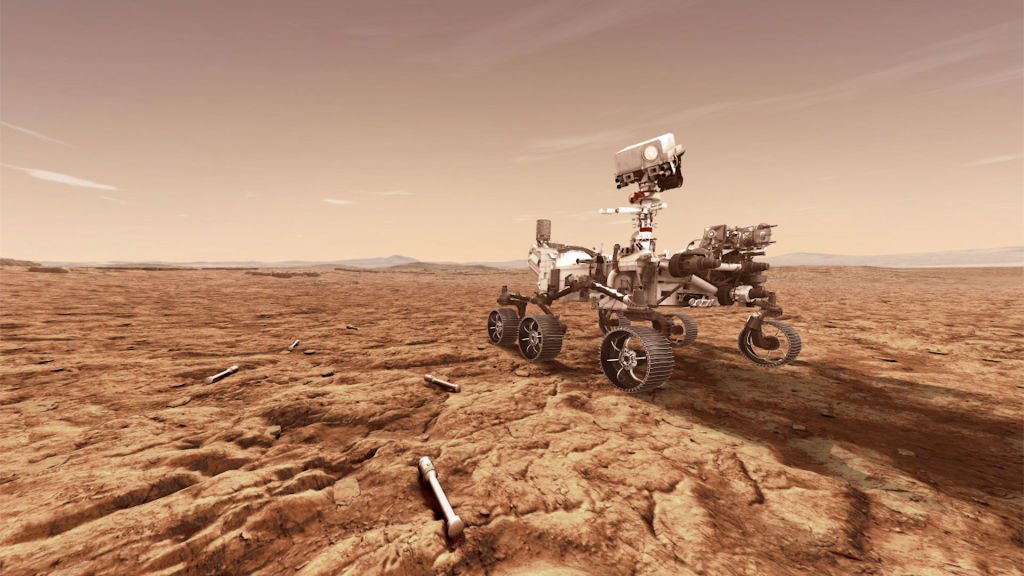
UNSPECIFIED: In this concept illustration provided by NASA, NASA's Perseverance (Mars 2020) rover will store rock and soil samples in sealed tubes on the planet's surface for future missions to retrieve in the area known as Jezero crater on the planet Mars. A key objective for Perseverance's mission on Mars is astrobiology, including the search for signs of ancient microbial life. The rover will characterize the planet's geology and past climate, paving the way for human exploration of the Red Planet, and be the first mission to collect and cache Martian rock and regolith. (Photo illustration by NASA via Getty Images)
SHARE

A mineral called siderite found abundantly in rock drilled by a NASA rover on the surface of Mars is providing fresh evidence of the planet’s warmer and wetter ancient past when it boasted substantial bodies of water and potentially harboured life.

The Curiosity rover, which landed on Mars in 2012 to explore whether Earth’s planetary neighbour was ever able to support microbial life, found the mineral in rock samples drilled at three locations in 2022 and 2023 inside Gale crater, a large impact basin with a mountain in the middle.

Siderite is an iron carbonate mineral. Its presence in sedimentary rocks formed billions of years ago offers evidence that Mars once had a dense atmosphere rich in carbon dioxide, a gas that would have warmed the planet through the greenhouse effect to the point that it could sustain bodies of liquid water on its surface.

There are features on the Martian landscape that many scientists have interpreted as signs that liquid water once flowed across its surface, with potential oceans, lakes and rivers considered as possible habitats for past microbial life.

Carbon dioxide is the main climate-regulating greenhouse gas on Earth, as it is on Mars and Venus. Its presence in the atmosphere traps heat from the sun, warming the climate.

Until now, evidence indicating that the Martian atmosphere previously was rich in carbon dioxide has been sparse. The hypothesis is that when the atmosphere, for reasons not fully understood, evolved from thick and rich in carbon dioxide to thin and starved of this gas, the carbon through geochemical processes became entombed in rocks in the planet’s crust as a carbonate mineral.

The samples obtained by Curiosity, which drills 1.2 to 1.6 inches (3-4 centimetres) down into rock to study its chemical and mineral composition, lend weight to this notion. The samples contained up to 10.5% siderite by weight, as determined by an instrument onboard the car-sized, six-wheeled rover.

“One of the longstanding mysteries in the study of Martian planetary evolution and habitability is: if large amounts of carbon dioxide were required to warm the planet and stabilize liquid water, why are there so few detections of carbonate minerals on the Martian surface?” said University of Calgary geochemist Benjamin Tutolo, a participating scientist on NASA’s Mars Science Laboratory Curiosity rover team and lead author of the study published on Thursday in the journal Science.

“Models predict that carbonate minerals should be widespread. But, to date, rover-based investigations and satellite-based orbital surveys of the Martian surface had found little evidence of their presence,” Tutolo added.

Because rock similar to that sampled by the rover has been identified globally on Mars, the researchers suspect it too contains an abundance of carbonate minerals and may hold a substantial portion of the carbon dioxide that once warmed Mars.

The Gale crater sedimentary rocks – sandstones and mudstones – are thought to have been deposited around 3.5 billion years ago, when this was the site of a lake and before the Martian climate underwent a dramatic change.

“The shift of Mars’ surface from more habitable in the past, to apparently sterile today, is the largest-known environmental catastrophe,” said planetary scientist and study co-author Edwin Kite of the University of Chicago and Astera Institute.

“We do not know the cause of this change, but Mars has a very thin carbon dioxide atmosphere today, and there is evidence that the atmosphere was thicker in the past. This puts a premium on understanding where the carbon went, so discovering a major unsuspected deposit of carbon-rich materials is an important new clue,” Kite added.

The rover’s findings offer insight into the carbon cycle on ancient Mars.

On Earth, volcanoes spew carbon dioxide into the atmosphere, and the gas is absorbed by surface waters – mainly the ocean – and combines with elements such as calcium to form limestone rock. Through the geological process called plate tectonics, this rock is reheated and the carbon is ultimately released again into the atmosphere through volcanism. Mars, however, lacks plate tectonics.

“The important feature of the ancient Martian carbon cycle that we outline in this study is that it was imbalanced. In other words, substantially more carbon dioxide seems to have been sequestered into the rocks than was subsequently released back into the atmosphere,” Tutolo said.

“Models of Martian climate evolution can now incorporate our new analyses, and in turn, help to refine the role of this imbalanced carbon cycle in maintaining, and ultimately losing, habitability over Mars’ planetary history,” Tutolo added.

Subscribe to Our Newsletter
Subscribe to our newsletter to get our newest articles instantly!
[mc4wp_form]
Share This Article
Email Copy Link Print
Previous Article Watch: Intergalactic Space Reveals Missing Half of the Universe’s Visible Matter
Next Article Do You Find Bowling Difficult? Perfect Strikes Could Be Yours With This Science-Proven Trick
Leave a Comment

Leave a Reply Cancel reply

Your email address will not be published. Required fields are marked *

Editor's Pick

Sanjay Malhotra

RBI Governor Sanjay Malhotra Says India Must Shape Its AI Future

RBI Governor Sanjay Malhotra Says India Must Shape Its AI Future Reserve Bank of India Governor Sanjay Malhotra has stressed…

By Admin
6 Min Read
Nextkoder
Nextkoder Brings Modern Software Development and Business Automation to Mumbai Companies

As businesses become increasingly dependent on technology, having a basic website is…

4 Min Read
Langur Mimicry Artists Deployed for Badminton Worlds in Delhi

Langur Mimicry Artists to Keep Monkeys Away From Badminton Worlds The upcoming…

5 Min Read

Most Viewed Stories

TISS Students Denied Bail Over Slogans, Maoist Books

A court has denied anticipatory bail to two students of…

August 8, 2026

Noor Communications Brings Board-Level iPhone Repair Expertise to Gurgaon Customers

Noor Communications is reporting steady growth…

August 4, 2026

A New Chapter in Indian Education: ‘Self Defence Science’ and the Vision of Central Government’s Bhartiya Shiksha Board

New Delhi: India’s education landscape is…

March 18, 2026

Shankaracharya Avimukteshwaranand’s Dharma Yudh Yatra Held Amid Tense Atmosphere Under Impeccable Security by Kalki Sena Commandos

Lucknow / Varanasi | Special Report…

March 16, 2026

Goutham Kool Monkk Pays Tribute to India’s Unsung Heroes With “Vande Mataram”

The original patriotic anthem “Vande Mataram”…

January 27, 2026

You Might Also Like

Science

Nikku Madhusudhan: The Scientist of Indian Heritage Who Discovered Potential Extraterrestrial Life

Indian-British astrophysicist Dr Nikku Madhusudhan and his team at Cambridge University have identified potential signs of alien life on a…

1 Min Read
Science

Can Cannabis Help with Cancer Treatment? The Findings of the Largest Study Ever

A new study has uncovered significant evidence supporting the use of medical cannabis in cancer treatment. The study suggests medical…

4 Min Read
Science

Do You Find Bowling Difficult? Perfect Strikes Could Be Yours With This Science-Proven Trick

Scientists have finally discovered the method for throwing perfect strikes in tenpin bowling, thanks to the work of mathematician Leonhard…

3 Min Read
Science

Watch: Intergalactic Space Reveals Missing Half of the Universe’s Visible Matter

The long-sought missing half of the observable matter in the Universe has finally been found by scientists, who have found…

2 Min Read
chennaiweekly

About us

ChennaiWeekly.com is your trusted digital gateway to the vibrant pulse of Tamil Nadu’s capital and beyond. Established with a commitment to delivering timely, accurate, and insightful news.

Main Links

  • Business
  • Entertainment
  • Entrepreneur
  • Finance
  • Lifestyle

Main Catgories

  • News
  • Science
  • Sports
  • Technology
  • World

All Pages

  • About
  • Contact
  • Disclaimer
  • Terms & Conditions

More

  • Privacy Policy
  • Advertising Policy
  • Content Policy

© 2025 Chennai Weekly. All Rights Reserved.

Welcome Back!

Sign in to your account

Username or Email Address
Password

Lost your password?