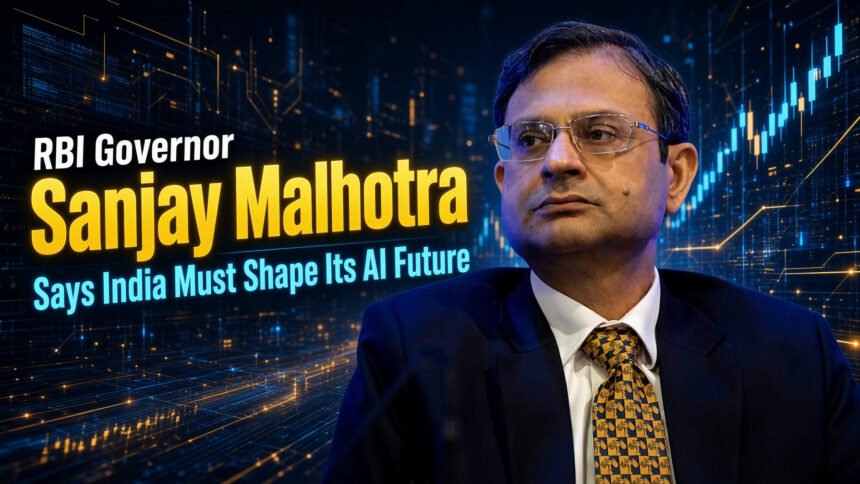
RBI Governor Sanjay Malhotra Says India Must Shape Its AI Future
Reserve Bank of India Governor Sanjay Malhotra has stressed the need for India to take an active role in shaping its artificial intelligence journey rather than simply reacting to developments as the technology advances.
His comments come at a time when AI is rapidly becoming part of India’s financial and business sectors. Malhotra has highlighted both the opportunities created by AI and the need for stronger oversight, accountability and responsible adoption.
India Cannot Remain a Passive Observer
The rapid development of artificial intelligence is creating opportunities across industries, from banking and lending to healthcare, education and technology.
For India, the challenge is to make sure the country’s AI ecosystem develops in a way that supports innovation while also addressing risks.
Malhotra’s message is that India should help determine how AI is developed, deployed and regulated instead of allowing the technology’s future to be shaped entirely by outside forces.
AI Could Transform India’s Banking Sector
The RBI governor has also highlighted the potential of AI in financial services.
At the FIBAC 2026 conference, Malhotra compared the potential impact of AI on lending with the transformation that UPI brought to digital payments. He urged banks to actively embrace the technology rather than remain passive observers.
AI could potentially help lenders improve credit assessment, expand access to financial services and make lending more efficient.
Human Oversight Remains Important
While Malhotra sees significant potential in AI, he has also stressed that technology should not replace human accountability.
He recently called on banks to maintain meaningful human oversight when using AI for decision-making. According to the RBI governor, responsibility cannot simply be shifted to an algorithm or technology provider when something goes wrong.
This approach places accountability at the centre of India’s AI adoption strategy.
AI Brings New Risks Too
The rapid adoption of AI also creates new challenges for financial institutions.
Malhotra has pointed to concerns including cybersecurity threats, algorithmic bias and excessive dependence on technology. The RBI is also seeking greater transparency around the AI systems being used by banks.
For financial institutions, understanding these risks will be just as important as adopting the technology itself.
Regulation Must Keep Up With Technology
AI is developing much faster than many traditional regulatory systems were designed to handle.
The RBI has already been working on a framework for responsible and ethical AI use in the financial sector. A committee’s FREE-AI framework was submitted to the RBI in August 2025, outlining recommendations focused on responsible and trustworthy AI adoption in finance.
The broader challenge for India will be finding the right balance between encouraging innovation and protecting consumers.
AI Could Become a Major Growth Driver
Malhotra has compared the significance of AI in the current decade with the impact of digitisation in the previous one.
For India, the opportunity is particularly important because the country already has a large digital infrastructure and a growing technology ecosystem. If AI is adopted responsibly, it could improve productivity, financial inclusion and access to services.
At the same time, regulators will need to ensure that the benefits of AI do not come at the cost of consumer protection or financial stability.
Final Thoughts
RBI Governor Sanjay Malhotra’s comments highlight a larger question for India: how should the country shape its AI future?
The answer will likely involve a combination of innovation, responsible adoption, human oversight and effective regulation.
As AI becomes increasingly important to banking and the wider economy, India has an opportunity to play an active role in determining how the technology is developed and used rather than simply adapting to changes created elsewhere.
Frequently Asked Questions
What did Sanjay Malhotra say about India’s AI future?
RBI Governor Sanjay Malhotra has stressed that India should take an active role in shaping its AI journey while ensuring responsible adoption and effective oversight.
What does AI mean for India’s banking sector?
AI could transform areas such as lending, credit assessment, fraud detection and financial inclusion. Malhotra has compared its potential impact on lending with the transformation UPI brought to payments.
Does RBI support the use of AI?
Yes. The RBI recognises the potential benefits of AI but has also emphasised responsible use, transparency, cybersecurity and human accountability.
Why is human oversight important in AI?
Human oversight ensures that important decisions remain accountable to people rather than being left entirely to algorithms or automated systems. Malhotra has specifically stressed this point for banks using AI.
What are the major risks of AI in banking?
Some key concerns include cybersecurity threats, algorithmic bias, data risks and excessive dependence on automated systems.
Is India working on AI regulation?
Yes. The RBI has been developing approaches for responsible AI adoption in the financial sector, including the FREE-AI framework submitted in 2025.
Why is AI important for India?
AI could improve productivity, financial inclusion, business efficiency and public services. At the same time, India needs appropriate safeguards to ensure the technology develops responsibly.