A fragile coastal ecosystem under threat
The coastal region surrounding the Uppanar backwater river in Cuddalore district, Tamil Nadu, represents one of the most delicate and ecologically important landscapes along India’s eastern shoreline. Stretching for nearly 15 kilometres parallel to the Bay of Bengal, the Uppanar waterway forms a natural coastal system that supports mangrove forests, marine biodiversity, and the livelihoods of thousands of fishing families.
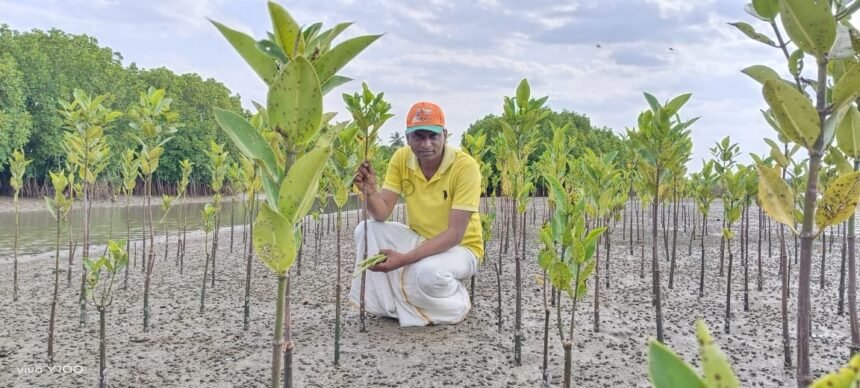
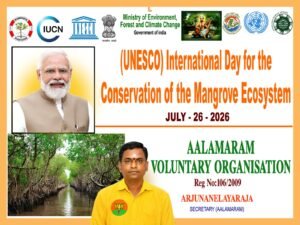
For more than a decade, local environmental organizations and community volunteers have been working to restore this fragile ecosystem. Among them, Aalamaram NGO, based in Cuddalore and led by environmental activist Arjunan Elayaraja, has been actively engaged in large-scale mangrove restoration and coastal conservation.
However, recent activities involving deep channel excavation and large-scale sand removal along the Uppanar coastal belt have raised serious environmental concerns. Experts and local communities warn that these actions could dismantle natural coastal defenses that protect the region from flooding, sea erosion, and extreme climate events.
Community-led mangrove restoration along the Uppanar
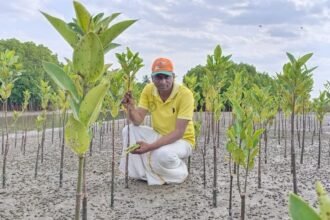
Since 2010, volunteers from Aalamaram NGO have planted thousands of mangrove saplings along a 15-kilometre stretch of the Uppanar backwater river. Over the years, these saplings have grown into thriving mangrove forests that now play a crucial role in stabilizing the coastal ecosystem.
Mangrove forests serve several essential functions:
- Protecting shorelines from storm surges and sea erosion
- Acting as breeding grounds for fish and marine organisms
- Providing habitat for migratory birds, crabs, shrimp and other species
- Supporting the livelihoods of fishermen who depend on coastal fisheries
These mangrove ecosystems have gradually restored a previously damaged coastal environment and now serve as an ecological shield for nearby areas, including the SIPCOT industrial region in Cuddalore.
The mangrove restoration efforts have also transformed the Uppanar coastal landscape into an emerging ecological zone similar to the famous Pichavaram mangrove forests near Chidambaram.
Sand dunes: the coast’s invisible protective wall
While mangroves play a crucial ecological role, sand dunes are equally important natural barriers along the coastline.
Sand dunes are formed naturally over decades through the interaction of wind, vegetation, and coastal sediment. These dunes serve as a protective wall between the sea and inland villages.
Their environmental functions include:
- Preventing sea water intrusion into inland areas
- Absorbing the impact of waves and storm surges
- Protecting coastal villages from flooding
- Supporting coastal vegetation and biodiversity
- Maintaining natural drainage of rainwater
In coastal fishing villages such as Thiruchopuram, Periyakuppam, and Nayinaikuppam, sand dunes have historically protected communities from extreme coastal events.
These natural formations are particularly vital during heavy monsoon rains and cyclones, when they prevent seawater from flooding inland settlements.
A coastline still recovering from the 2004 tsunami
The importance of these natural barriers became painfully evident during the 2004 Indian Ocean tsunami, which devastated several coastal districts in Tamil Nadu, including Cuddalore.
Many coastal villages in the Uppanar region were severely affected by the disaster. The tragedy highlighted the critical importance of natural protective systems such as mangrove forests and sand dunes.
Since then, environmental experts have repeatedly emphasized that tsunami-affected coastal areas must be protected through ecological restoration rather than disruptive development projects.
The controversial channel-digging project
Despite these concerns, a government project has been initiated to dig a deep channel—approximately 30 feet deep—connecting the Uppanar backwaters directly to the sea.
According to environmental groups and local activists, this project involves the large-scale removal of sand dunes along the coastal belt.
Critics argue that the excavation process is destroying natural sand barriers that have protected coastal villages for decades. Large quantities of sand are reportedly being removed from areas between Thiruchopuram, Periyakuppam, and Nayinaikuppam, fundamentally altering the natural coastal landscape.
Environmentalists warn that removing sand dunes in this manner goes against natural coastal protection mechanisms.
Concerns about environmental governance
Another major concern raised by activists and local organizations is the apparent conflict between state-level actions and central government environmental policies.
The Central Government has supported coastal protection programs, including mangrove afforestation and ecological restoration initiatives aimed at strengthening natural coastal defenses.
However, critics argue that the current sand removal and channel-digging project contradicts these conservation goals.
Environmental groups claim that while the Central Government promotes mangrove protection and coastal resilience, the ongoing project by the Tamil Nadu State Government is weakening these very natural barriers.
This contradiction has raised serious questions about environmental governance and policy coordination.
Impact on fishing communities and local livelihoods
For thousands of families living along the Cuddalore coastline, the sea is not just a geographical feature—it is the foundation of their livelihood.
Fishing villages depend heavily on:
- Healthy coastal ecosystems
- Mangrove breeding grounds for fish
- Stable shorelines protected by sand dunes
If sand dunes are destroyed and mangroves are damaged, the consequences could be devastating for these communities.
Possible impacts include:
- Increased coastal erosion
- Flooding during cyclones and storms
- Loss of fish breeding grounds
- Saltwater intrusion into freshwater sources
- Displacement of fishing families
Without natural barriers, coastal villages could become far more vulnerable to climate-related disasters.
Global environmental attention
The issue has also drawn attention from the Global Landscape Forum, an international environmental platform associated with global environmental governance and discussions under the United Nations framework.
Experts connected with this platform have highlighted the importance of protecting sand dunes and mangrove ecosystems as critical tools for climate resilience and disaster prevention.
Their observations reinforce the argument that natural coastal barriers should not be disturbed, particularly in regions already vulnerable to sea-level rise, storms, and coastal erosion.
Nature-based protection versus artificial intervention
Modern environmental science increasingly emphasizes nature-based solutions for coastal protection. Mangrove forests and sand dunes together form a natural defense system that can absorb the impact of storms, prevent erosion, and stabilize coastlines.
Destroying these systems in favour of large-scale engineering interventions can often create more environmental problems than it solves.
In the Uppanar coastal belt, environmental advocates argue that removing sand dunes and altering natural waterways contradicts the principles of sustainable coastal management.
The need for urgent environmental protection
The coastal ecosystem of Cuddalore is not only an environmental asset but also a social and economic lifeline for thousands of people.
Organizations like Aalamaram NGO have demonstrated how community-driven conservation efforts can restore degraded ecosystems and strengthen coastal resilience.
Their work in planting mangroves along the Uppanar river has already shown positive ecological results. Protecting sand dunes alongside these mangroves is essential to maintaining the region’s environmental balance.
Conclusion
The Uppanar coastal ecosystem represents a rare combination of natural beauty, biodiversity, and community resilience. Mangrove forests and sand dunes together form a natural shield protecting coastal villages from environmental threats.
In a region that has already experienced the devastating impact of the 2004 tsunami, preserving these natural barriers is not just an ecological necessity—it is a matter of survival for coastal communities.
Experts, environmental organizations, and local residents are calling for careful reconsideration of projects that may damage these fragile ecosystems. Protecting the Uppanar mangroves and sand dunes today will ensure that the coastal communities of Cuddalore remain safe, sustainable, and resilient for generations to come.