Stock Market Dips as US Treasury Yields Rise, Sensex Opens at 72,441 and Nifty Near 22,665
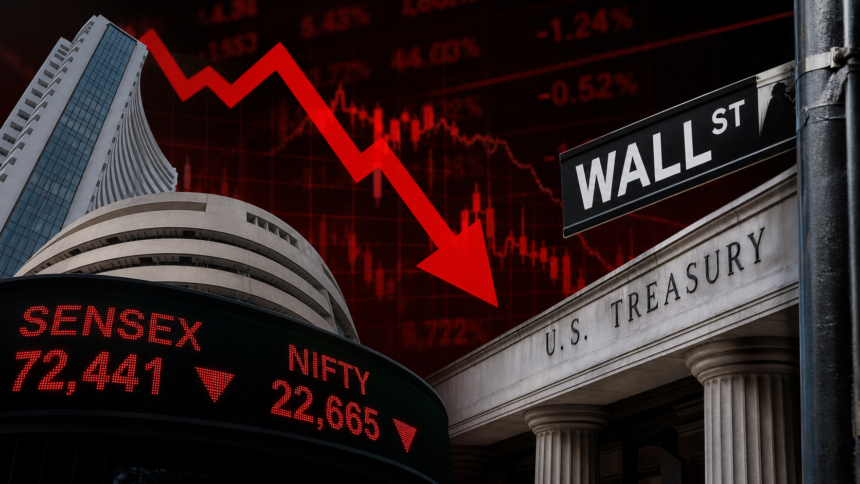
The stock market today opened on a cautious note as rising US Treasury yields continued to weigh on investor sentiment. Indian benchmark indices started Wednesday’s session in negative territory, with the BSE Sensex opening at 72,441.15, down 87.92 points, while the Nifty 50 opened at 22,665, lower by around 50 points or 0.23%.
The weak opening followed another subdued session on Wall Street and came as investors continued to monitor elevated US bond yields, crude oil prices, currency movements and global economic signals.
Sensex and Nifty Open Lower
The Sensex began the September 30 trading session at 72,441.15, representing a decline of nearly 88 points from its previous close. The Nifty opened around 22,665, extending the cautious tone seen in the previous session.
The opening decline was relatively limited, indicating that investors were cautious rather than reacting to a sharp overnight sell-off.
The broader market, meanwhile, showed mixed performance, with several sectors moving higher even as the major benchmarks remained under pressure.
Rising US Treasury Yields Remain a Key Concern
One of the major global factors affecting the stock market today was the continued rise in US Treasury yields.
The 10-year US Treasury yield had climbed to around 5.293% on Tuesday, its highest level since June 2007, while the 30-year Treasury yield reached approximately 5.62%, its highest level since June 2002.
Higher Treasury yields can influence global equity markets because they increase the attractiveness of US fixed-income assets while also raising the discount rate used by investors to value stocks.
For emerging markets such as India, elevated US yields can also contribute to pressure on currencies and foreign capital flows.
Wall Street Also Ends Lower
The overnight performance of US markets added to the cautious mood in Asia.
On September 29, the Dow Jones Industrial Average declined 131.59 points, or 0.26%, to 51,349.92. The S&P 500 fell 12.85 points, or 0.17%, to 7,670.84, while the Nasdaq Composite slipped 22.84 points, or 0.08%, to 26,797.54.
The US market weakness came as investors assessed rising government bond yields and awaited important economic data that could influence expectations around Federal Reserve interest rates.
Indian Investors Watch Global Cues
The Indian market has remained sensitive to movements in global bond yields, crude oil and the US dollar.
The previous session saw the Sensex fall 242.65 points to 72,529.07, while the Nifty declined 64.05 points to close at 22,716.20.
The September correction has therefore kept investors focused on whether global headwinds will continue to pressure domestic equities or whether lower crude prices and improving global sentiment can provide some support.
Sectoral Performance Remains Mixed
Despite the weak benchmark opening, market performance across sectors was uneven.
The Nifty MidSmall IT & Telecom index gained more than 1% in early trade, while PSU banks, chemicals, oil and gas, cement and media stocks also recorded gains.
On the other hand, the Nifty Metal index declined around 0.42%, while healthcare and pharmaceutical stocks also traded slightly lower.
The mixed movement suggests that investors were continuing to rotate between sectors instead of uniformly selling equities.
Crude Oil Adds Another Layer of Uncertainty
Oil prices also remained an important factor for Indian equities.
Brent crude was trading around $103.32 a barrel in early Asian trade, while West Texas Intermediate crude was around $89.71.
Higher crude prices can be significant for India because the country relies heavily on imported oil. Rising energy costs can affect inflation, corporate margins and the country’s trade balance.
At the same time, any sustained decline in crude prices could provide some relief to Indian equities and the rupee.
Rupee Remains Near the 96-per-Dollar Level
The Indian rupee also remained under pressure during early trading. The currency opened at 95.87 per US dollar and weakened to around 95.97, while state-run bank dollar sales helped keep the exchange rate below the psychologically important 96 level.
Firm crude prices, foreign portfolio outflows and elevated US bond yields were among the factors influencing the currency market.
A weaker rupee can increase the cost of imported commodities, although export-oriented sectors may benefit from higher overseas earnings when converted into rupees.
What Investors Are Watching Next
Market participants are likely to remain focused on US bond yields, crude oil prices, global economic data and developments in international markets.
Technical levels are also being closely monitored. Market analysts cited support around the 22,650–22,700 zone for the Nifty, while the 22,950–23,000 area was identified as an important resistance range.
The direction of US Treasury yields could remain particularly important. A continued rise in long-term yields could keep pressure on global equity valuations, while a moderation could ease some of the concerns affecting emerging markets.
For Indian equities, movements in crude oil and the rupee will also remain important alongside domestic corporate and economic developments.
FAQs
1. Why did the Indian stock market open lower today?
The Indian stock market opened lower amid elevated US Treasury yields, cautious global cues, crude oil movements and currency pressure.
2. At what level did the Sensex open?
The Sensex opened at 72,441.15 on September 30, 2026, down 87.92 points.
3. At what level did the Nifty open?
The Nifty 50 opened at around 22,665, down approximately 50 points or 0.23%.
4. Why are US Treasury yields important for Indian stocks?
Higher US Treasury yields can make US bonds relatively more attractive and increase global borrowing costs, potentially putting pressure on emerging-market equities.
5. What happened to the 10-year US Treasury yield?
The 10-year US Treasury yield climbed to around 5.293% on September 29, its highest level since June 2007.
6. What happened to the 30-year Treasury yield?
The 30-year US Treasury yield reached approximately 5.62%, its highest level since June 2002.
7. How did Wall Street perform?
The Dow, S&P 500 and Nasdaq all ended lower on September 29, with declines of about 0.26%, 0.17% and 0.08%, respectively.
8. How did the rupee perform?
The rupee opened at 95.87 per US dollar and weakened to around 95.97 in early trading on September 30.
9. Are crude oil prices affecting Indian stocks?
Yes. Crude prices remain an important factor because India is heavily dependent on imported oil, making energy prices relevant for inflation, the trade balance and corporate costs.
10. What factors could influence the stock market next?
Investors are likely to track US Treasury yields, crude oil prices, the rupee, global equity markets, upcoming economic data and domestic corporate developments.