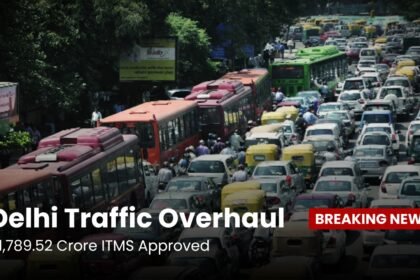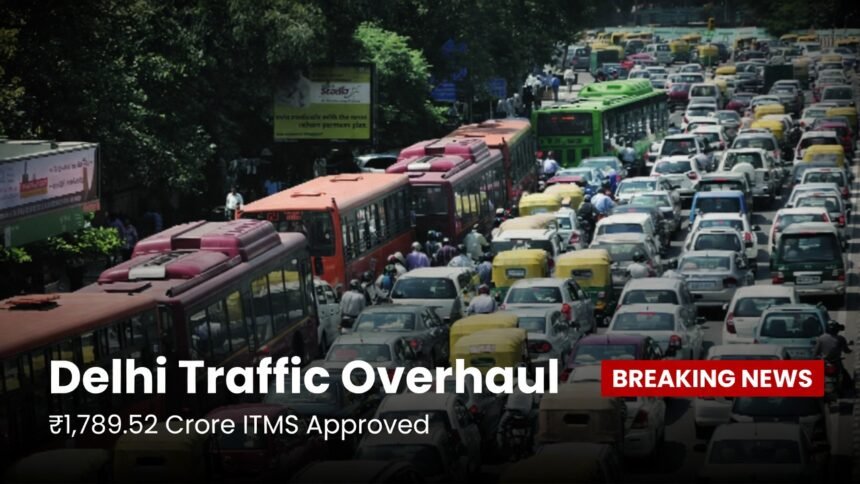
Delhi Approves ₹1,789.52 Crore Delhi ITMS for 42 Traffic Corridors
The Delhi ITMS project has received approval for a major ₹1,789.52 crore investment aimed at modernising traffic management across the national capital. The Cabinet Committee on Economic Affairs (CCEA) approved the Intelligent Traffic Management System (ITMS) for implementation by the Delhi Police on September 30, 2026.
The technology-led project will cover 42 identified traffic corridors and combine AI-enabled adaptive traffic signals, automated enforcement, real-time traffic information and integrated command-and-control systems. It is scheduled to be implemented in three phases over 24 months, followed by five years of operation and maintenance.
What Is the Delhi ITMS Project?
The Delhi ITMS is designed to make traffic management more responsive to actual road conditions rather than relying primarily on fixed signal timings and manual intervention.
According to the government, the system will use real-time traffic data to adjust signal timings, coordinate signals along identified corridors and provide authorities with information about congestion and incidents.
The project includes 1,092 Adaptive Traffic Control System locations and 1,029 enforcement locations across the identified corridors.
This means the investment is not limited to upgrading individual traffic lights. It is planned as an integrated system connecting traffic signals, enforcement infrastructure, monitoring systems and control centres.
AI-Enabled Signals to Respond to Traffic Conditions
One of the major components of the Delhi ITMS will be adaptive traffic signals.
Unlike conventional signals that operate according to predetermined timings, adaptive systems can adjust signal cycles based on prevailing traffic conditions. Signals along a corridor can also be coordinated to improve vehicle movement and reduce unnecessary stops.
The government says the system will help make better use of Delhi’s existing road capacity by allowing traffic management to respond dynamically to changing conditions.
The project comes as Delhi continues to deal with a large and growing vehicle population. The official release notes that the capital has around 71 lakh active registered vehicles, while vehicle growth has outpaced the expansion of road infrastructure.
Automated Enforcement Across 1,029 Locations
Another important element of the project is technology-based traffic enforcement.
The ITMS will have 1,029 enforcement locations designed to support automated detection of traffic violations. Reported applications include detection of speeding, red-light and stop-line violations, wrong-side driving, illegal parking and violations involving helmets, seat belts and mobile-phone use while driving.
Automated enforcement can provide authorities with continuous monitoring and reduce dependence on manual detection at individual locations.
The system is also intended to strengthen the use of data in identifying traffic violations and managing enforcement operations.
Emergency Vehicles to Get Priority
The new system is also designed to support quicker movement of emergency vehicles such as ambulances.
Real-time traffic information and connected signal systems can allow authorities to manage traffic flows along routes being used by emergency vehicles. The government says the ITMS will facilitate priority movement for ambulances and support faster responses to road incidents and congestion.
The objective is to integrate emergency response into the broader traffic-management network instead of treating it as a separate operation.
Real-Time Traffic Information for Commuters
The Delhi ITMS will also provide real-time information about traffic conditions.
The planned system is expected to generate congestion alerts and provide information about traffic movement, incidents and diversions. Such information can also support commuter-facing services and navigation systems.
For daily commuters, access to more timely information could help them understand congestion conditions and potential disruptions before or during a journey.
Integrated Traffic Command and Control Centres
The project will bring traffic regulation, enforcement and information dissemination onto a common technological platform through Traffic Command and Control Centres.
These centres will be supported by secure data-centre and disaster-recovery infrastructure. The system is also planned around open standards and APIs, allowing future integration and expansion.
This integrated approach is intended to give traffic authorities a more comprehensive view of what is happening across different parts of the city.
Instead of managing individual signals or incidents in isolation, the system will connect information from multiple traffic-management components.
Delhi ITMS to Be Implemented in Three Phases
The ₹1,789.52 crore project will not be deployed across all 42 corridors simultaneously.
According to the Cabinet approval, implementation will take place in three phases over 24 months. Each subsequent phase will be taken up after the preceding phase is evaluated against prescribed testing, commissioning, acceptance and performance parameters.
Following implementation, the project includes five years of operation and maintenance.
Delhi Police will implement the system through a Master System Integrator selected through competitive bidding, while the Centre for Development of Advanced Computing (C-DAC) will provide technical support as Project Management Consultant.
Why the Investment Matters for Delhi’s Traffic Network
Delhi’s traffic system has to manage a high volume of vehicles on a road network where expansion is constrained by the city’s existing urban structure.
The Delhi ITMS takes a technology-focused approach by attempting to improve the management of existing infrastructure through better data, coordinated signals and automated enforcement.
The project is therefore focused not only on physical road construction but also on improving how traffic moves across the network.
Its effectiveness will depend on implementation, system reliability, integration between different components and how successfully traffic data is converted into real-time operational decisions.
What the ₹1,789.52 Crore Project Includes
The major components of the approved system include:
- Project cost: ₹1,789.52 crore, including taxes
- Coverage: 42 identified traffic corridors
- Adaptive traffic-control locations: 1,092
- Enforcement locations: 1,029
- Implementation: Three phases
- Initial rollout period: 24 months
- Operation and maintenance: Five years after implementation
- Implementing agency: Delhi Police
- Technical support: C-DAC
- Core technologies: AI-enabled adaptive signals, real-time traffic data, automated enforcement and integrated command-and-control systems
A Technology-Led Shift in Delhi Traffic Management
The approval of the Delhi ITMS marks a planned shift toward a more connected and data-driven traffic-management system.
The project brings together adaptive signals, automated enforcement, emergency-vehicle priority, real-time traffic information and centralised monitoring under one framework.
As implementation progresses across the 42 corridors, the focus will move from project approval to deployment, testing and integration. The three-phase structure is intended to allow each stage to be evaluated before the next phase begins.
For Delhi commuters, the most visible changes are expected to come through traffic-responsive signals, automated enforcement and improved access to real-time traffic information.
FAQs
1. What is the Delhi ITMS?
Delhi ITMS stands for Intelligent Traffic Management System. It is a technology-based traffic-management project using real-time data, adaptive signals, automated enforcement and integrated command-and-control systems.
2. How much has been approved for the Delhi ITMS?
The Cabinet Committee on Economic Affairs approved ₹1,789.52 crore, including taxes, for the project.
3. How many corridors will the Delhi ITMS cover?
The project will cover 42 identified traffic corridors across Delhi.
4. How many adaptive traffic signal locations are planned?
The approved system includes 1,092 Adaptive Traffic Control System locations.
5. How many enforcement locations will be included?
The project includes 1,029 enforcement locations for technology-based traffic enforcement.
6. Will the new signals use AI?
Yes. The project includes AI-enabled adaptive traffic signals that can adjust signal timings based on real-time traffic conditions.
7. Will ambulances receive priority under the system?
The ITMS is designed to facilitate priority movement for ambulances and support faster responses to congestion and road incidents.
8. Who will implement the Delhi ITMS?
Delhi Police will implement the project through a Master System Integrator selected through competitive bidding. C-DAC will provide technical support as the Project Management Consultant.
9. How long will implementation take?
The project is planned to be implemented in three phases over 24 months, followed by five years of operation and maintenance.
10. Will the ITMS provide real-time traffic information?
Yes. The system is designed to provide real-time traffic information, congestion alerts and incident-related information as part of its integrated traffic-management platform.