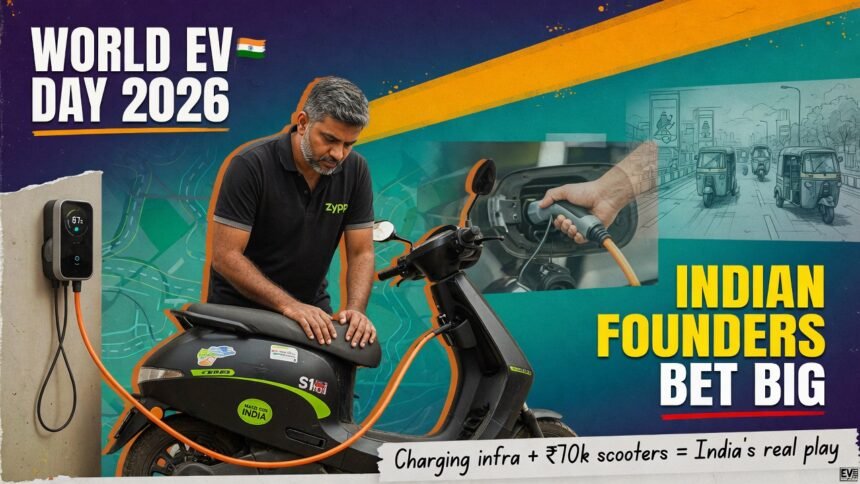
World EV Day 2026: Indian EV Founders Bet on Charging Infrastructure and Affordable Two-Wheelers
World EV Day 2026 is putting the spotlight on the next phase of India’s electric mobility journey, with startup founders and industry leaders increasingly shifting their focus from simply increasing EV sales to making electric mobility more affordable, accessible and practical for everyday consumers.
Observed globally on September 9, World EV Day 2026 carries the theme “Switching Electric: driving down the cost of motoring.” The theme places affordability at the centre of the electric mobility conversation.
For India, the message is particularly relevant. As electric two-wheelers expand beyond major metropolitan markets, founders believe the next phase of growth will depend heavily on stronger charging networks, battery infrastructure, affordable products and deeper penetration into Tier 2 and Tier 3 cities.
World EV Day 2026 Highlights a New Phase for India
India’s EV industry has moved beyond the early-adoption stage. The key question now is how quickly electric mobility can become mainstream.
Industry leaders speaking around World EV Day have pointed to financing, charging infrastructure, localisation, supply chains and coordinated policy as some of the most important factors for the next stage of growth.
This represents a shift in the industry’s priorities. Instead of focusing only on vehicle launches and sales numbers, companies are increasingly looking at the larger ecosystem required to support millions of EV users.
That includes where vehicles will charge, how quickly they can recharge, how batteries can be serviced or swapped and whether consumers can afford electric vehicles without compromising on reliability.
Affordable Electric Two-Wheelers Could Drive Mass Adoption
Electric two-wheelers remain one of the most important segments for India’s EV transition because motorcycles and scooters are central to everyday personal mobility.
Oben Electric Founder and CEO Madhumita Agrawal said the next opportunity lies particularly in electric motorcycles, with accessible pricing, dependable products, convenient charging and strong after-sales support needed to take EV adoption deeper into the mass market.
The focus on affordability is important because India’s two-wheeler market extends far beyond premium urban consumers.
For many buyers, an EV must compete directly with petrol motorcycles and scooters on upfront price, range, running costs, servicing and convenience.
Tier 2 and Tier 3 Cities Become the Next Battleground
The expansion of electric mobility is also moving beyond India’s largest cities.
Zelio E-Mobility’s leadership has highlighted Tier 2 and Tier 3 cities as an important part of the next adoption wave. In these markets, electric two-wheelers can address everyday commuting requirements while offering potentially lower running costs.
However, adoption in smaller cities also depends on trust.
Consumers need dependable local service centres, easy access to spare parts, transparent battery warranties and sufficient charging options before they are likely to make the switch at scale.
This means EV manufacturers may increasingly have to build distribution and service networks alongside their vehicle portfolios.
Charging Infrastructure Becomes a Top Priority
One of the biggest challenges for India’s EV ecosystem remains charging infrastructure.
As more electric vehicles enter the market, charging capacity needs to grow alongside them. Industry discussions around World EV Day have therefore placed greater emphasis on building reliable and accessible charging networks.
The challenge is not simply the number of chargers installed.
For consumers, charger availability, uptime, location, charging speed, compatibility and payment convenience all influence the ownership experience.
For commercial fleets, the requirements can be even more demanding because vehicle downtime directly affects business economics.
Battery Swapping Could Complement Charging
Battery swapping is another area attracting attention as India develops its EV infrastructure.
Instead of waiting for a battery to recharge, compatible vehicles can exchange a depleted battery for a charged one. This model can be particularly useful for high-utilisation two-wheelers and commercial fleets where reducing downtime is critical.
The broader EV ecosystem is consequently moving toward multiple energy-delivery models rather than relying on one solution.
Home charging, public fast charging, workplace charging, fleet charging and battery swapping could all play different roles depending on the vehicle and user.
EV Infrastructure Must Grow With Vehicle Sales
A major concern for the industry is the possibility of vehicle adoption growing faster than supporting infrastructure.
An electric vehicle becomes significantly more practical when consumers know that charging is available when and where they need it.
This is why industry leaders are increasingly treating vehicles, charging, batteries, electricity supply and software as interconnected parts of the same ecosystem.
Smarten Power Systems Managing Director Arun Bhardwaj has argued that India’s next EV phase requires thinking about generation, charging, storage and consumption together, rather than treating charging infrastructure as an isolated issue.
India’s EV Growth Is Also an Energy Challenge
The expansion of EVs will have implications beyond the automobile industry.
As electricity demand from transportation grows, the country will need to consider how charging loads are managed and how renewable energy, storage and the electricity grid interact with EV adoption.
This creates opportunities for companies working in charging technology, battery management, energy storage, grid solutions and fleet software.
The EV industry is therefore increasingly becoming part of India’s broader energy-transition story.
Affordability Will Shape the Next Wave
The 2026 World EV Day theme is particularly relevant because the long-term success of electric mobility depends on reaching consumers beyond early adopters.
The industry’s next challenge is to make EVs financially attractive for ordinary commuters.
That means reducing vehicle costs, improving battery economics, expanding financing options and lowering the total cost of ownership.
India has also continued to support electric two-wheelers through policy measures. The PM E-DRIVE scheme for electric two-wheelers has been extended through March 2028, although incentives remain subject to the scheme’s funding limits.
The Industry Is Moving From Adoption to Scale
The central message emerging from World EV Day 2026 is that India’s EV story is entering a different stage.
The industry is no longer focused only on convincing consumers that electric vehicles are the future. The priority is increasingly about making that future work at scale.
That means affordable motorcycles and scooters, dependable charging, battery-swapping solutions, stronger after-sales networks and infrastructure that reaches smaller cities.
The winners of the next phase may therefore not simply be companies that sell the most EVs, but those capable of building the ecosystem around them.
What Indian EV Founders Are Betting On
The direction emerging from founder and industry perspectives can be summarised around several priorities:
Affordable products: Electric motorcycles and scooters that can compete with conventional two-wheelers on overall ownership economics.
Charging expansion: More reliable public, highway, fleet and destination charging networks.
Battery infrastructure: Greater use of battery management and swapping solutions where they make economic sense.
Tier 2 and Tier 3 expansion: Taking EV products and services beyond India’s largest urban markets.
After-sales support: Building consumer confidence through dependable servicing and local support.
Localisation: Strengthening India’s domestic EV and battery supply chain.
These priorities suggest that India’s EV transition is increasingly becoming an infrastructure-and-economics challenge rather than simply a technology challenge.
India’s EV Roadmap After World EV Day 2026
World EV Day 2026 provides a useful snapshot of where India’s electric mobility sector is heading.
The next few years are likely to see greater competition around affordable electric two-wheelers, charging networks, battery technologies and energy-management systems.
The industry is also likely to become more segmented, with different solutions emerging for private commuters, delivery workers, fleet operators, commercial vehicles and long-distance transportation.
As electric mobility moves deeper into mainstream Indian transportation, affordability and convenience could become just as important as vehicle technology.
Key Takeaway
World EV Day 2026 highlights a clear change in India’s electric mobility conversation. The industry’s next challenge is not merely selling more EVs, but building the infrastructure and economics required for mass adoption.
Indian EV founders are increasingly pointing toward affordable two-wheelers, wider charging networks, battery swapping, stronger after-sales support and deeper Tier 2 and Tier 3 penetration as key priorities.
If these pieces come together, India’s EV transition could move from an early-adopter phenomenon to a genuinely mass-market mobility shift.
FAQs
1. When is World EV Day 2026?
World EV Day 2026 is being observed on September 9, 2026. The official theme is “Switching Electric: driving down the cost of motoring.”
2. What is the focus of World EV Day 2026?
The 2026 campaign focuses on making electric mobility more affordable, with the cost of motoring and wider EV adoption at the centre of the discussion.
3. What are Indian EV founders focusing on?
Indian EV founders are increasingly focusing on affordable electric two-wheelers, charging infrastructure, battery solutions, after-sales support and expansion into smaller cities.
4. Why are electric two-wheelers important for India?
Two-wheelers are a major part of everyday mobility in India, making electric motorcycles and scooters an important route toward mass EV adoption.
5. Why is EV charging infrastructure important?
Reliable charging infrastructure reduces range anxiety and makes EV ownership more practical for commuters, fleets and long-distance travel.
6. What is battery swapping?
Battery swapping allows an EV user to replace a depleted battery with a charged battery instead of waiting for the vehicle’s battery to recharge.
7. Are Tier 2 and Tier 3 cities important for EV adoption?
Yes. Industry leaders increasingly see smaller cities as an important next market for electric two-wheelers, particularly because of everyday commuting needs and lower running costs.
8. Is affordability becoming more important for EV adoption?
Yes. The 2026 World EV Day theme itself focuses on reducing the cost of motoring, while Indian EV companies are increasingly targeting accessible products and lower total ownership costs.
9. What challenges does India’s EV industry still face?
Key challenges include charging availability, financing, affordability, battery technology, supply-chain localisation, after-sales support and policy coordination.
10. What could define India’s next EV growth phase?
Affordable electric two-wheelers combined with widespread charging infrastructure, battery solutions, reliable service networks and greater adoption outside major metropolitan areas could define India’s next EV growth phase.