India’s evolving defence and space technology landscape brings together military experience, artificial intelligence, psychological analysis and advanced scientific research. A reported low-cost innovation involving a specialised component developed by a team associated with DRDO has drawn attention to the possibilities of indigenous orbital technology.
The global race for space dominance is entering a new phase. The United States, China and Russia are investing heavily in space stations, orbital manoeuvring systems, advanced propulsion and technologies designed to sustain long-term human activity in space. As India advances its ambitions for an indigenous space station, the development of cost-effective, domestically designed technologies is becoming increasingly significant.
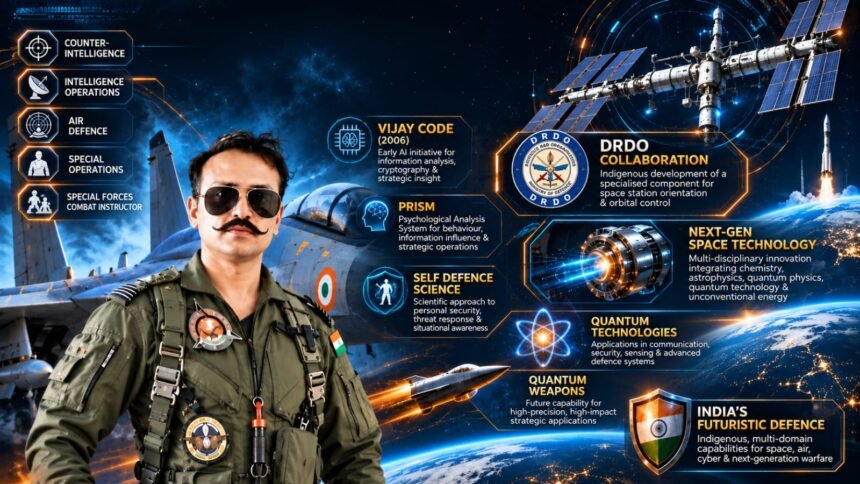
One of the developments attracting attention in this context is a specialised component reportedly developed by a team associated with Wing Commander (Dr.) Pushkal Vijay Dwivedi and DRDO. The component is intended to contribute to the control of a space station’s orientation and orbital positioning, an important capability for future space infrastructure.
The development also brings into focus a wider range of technological and strategic initiatives involving military veterans, defence research, artificial intelligence and unconventional scientific approaches.
The Technology Behind Orbital Manoeuvring
The ability to change a space station’s orientation, maintain its orbital position and execute necessary manoeuvres is fundamental to space operations. Such functions are associated with attitude control, orbital manoeuvring and propulsion technologies.
The component associated with the Dwivedi-led team incorporates concepts from multiple scientific disciplines, including chemistry, astrophysics, quantum physics, quantum technology and unconventional energy.
Its proposed significance lies in the combination of these disciplines within a specialised technological component designed for future space applications.
The development is particularly notable for its claimed cost advantage. Major spacefaring nations have committed substantial financial resources to advanced propulsion and orbital-control research. The Indian development aims to provide an advanced indigenous alternative at a considerably lower cost.
The invention has entered the patent application process, with Wing Commander Pushkal Vijay Dwivedi and his team identified as its inventors.
The component’s name, detailed design, chemical composition and complete operating specifications remain classified and are therefore not being disclosed publicly. Its potential application in India’s future space station programme makes the development strategically significant.
DRDO Collaboration and the Importance of Indigenous Research
India’s space and defence ambitions increasingly depend on indigenous research, technological self-reliance and collaboration between specialised research teams and national institutions.
The reported collaboration involving DRDO and the team associated with Dwivedi reflects the broader importance of multidisciplinary innovation in this sector.
Modern space technology is no longer restricted to conventional aerospace engineering. Advances in materials science, energy systems, computational physics, quantum technologies and chemical engineering are expanding the possibilities for developing new space systems.
The reported innovation also highlights the growing relevance of private-sector and specialist research contributions to India’s long-term space ambitions.
From Counter-Intelligence to Special Operations: The Military Background
The technological work has also brought attention to the military background of Wing Commander (Dr.) Pushkal Vijay Dwivedi.
During his Indian Air Force career, his areas of service included counter-intelligence, intelligence operations, air defence and special operations. These are among the operationally sensitive areas of modern military establishments, involving threat assessment, information security, operational planning and national defence.
His profile also includes experience as a combat instructor associated with Special Forces training.
Such operational experience provides a different perspective on technological development. Military requirements frequently demand systems that are reliable, efficient, economical and capable of functioning under demanding conditions.
The transition from military operations to research and technological development is part of a broader trend in which experienced defence personnel contribute to India’s indigenous innovation ecosystem.
Self Defence Science: Applying Military Principles Beyond the Battlefield
Another area associated with Dwivedi is Self Defence Science, an initiative that seeks to integrate conventional self-defence practices with scientific principles, human behaviour and psychology.
The concept extends beyond physical combat techniques. It includes threat recognition, situational awareness, reaction time, psychological preparedness and the ability to respond effectively under pressure.
The approach reflects the application of certain military training principles to civilian safety and practical self-protection.
Vijay Code: An Artificial Intelligence Initiative Dating Back to 2006
Artificial intelligence and information analysis are becoming central to modern military and intelligence operations. In this context, Vijay Code, attributed to Dwivedi and developed in 2006, is another initiative that has attracted attention.
The concept has been associated with cryptography, information processing and strategic analysis.
Its development dates back to a period when AI-based applications were not as widely accessible as they are today. The initiative has subsequently been discussed in the context of information warfare and next-generation military technologies.
The evolution of AI has fundamentally changed intelligence gathering, information processing, threat assessment and military decision-making. Initiatives exploring these intersections illustrate the growing relationship between defence experience and emerging technologies.
PRISM: The Psychological Dimension of Intelligence and Information Warfare
Another initiative associated with this broader technological portfolio is PRISM Psychological Analysis System.
Psychological analysis has become an important component of contemporary security studies. Modern conflicts increasingly involve information operations, narrative management, behavioural influence and psychological warfare.
Understanding human responses, decision-making patterns and the impact of information is therefore relevant to intelligence analysis and strategic planning.
The PRISM initiative is positioned within this wider intersection of psychology, behavioural analysis and information strategy.
Operation Sindoor and the Pakistan Connection
The aftermath of Operation Sindoor also brought Dwivedi’s name into discussions concerning intelligence-related activities and Pakistan.
An FIR was reportedly registered against him in Pakistan over allegations of anti-Pakistan activities and waging war against Pakistan. Major Nadeem, associated with the Sindh Regiment, has been identified in connection with the complaint.
The case has been linked to alleged intelligence operations against Pakistan, with Karachi cited as the location of the police complaint.
The development illustrates how intelligence-related activities can become part of the wider political and security discourse between the two countries.
India’s Next Frontier: The Strategic Importance of Space Technology
India’s proposed space station represents a major step in the country’s long-term space ambitions. Its development will require advances across several technological domains, including life-support systems, docking mechanisms, orbital control, propulsion, power management and autonomous operations.
Among these, orbital manoeuvring and attitude-control technologies will be particularly important for the safe and efficient operation of future space infrastructure.
The reported component developed by the team associated with Wing Commander Pushkal Vijay Dwivedi and DRDO is being positioned within this emerging technological landscape.
If successfully integrated and operationalised, such indigenous innovations could contribute to reducing dependence on expensive foreign technologies while strengthening India’s domestic research and development capabilities.
The larger story, therefore, extends beyond an individual or a single invention. It reflects the convergence of military experience, scientific research, private technological initiatives and national space ambitions.
As India prepares for the next phase of its space programme, the focus will increasingly be on technologies that combine advanced scientific principles with affordability, operational efficiency and indigenous engineering.